


Warts are benign formations on the skin and mucous membranes that are caused by the activation of the human papillomavirus.
They do not look aesthetically pleasing and often become the cause of complexes.You want to get rid of them, but you don't know how.
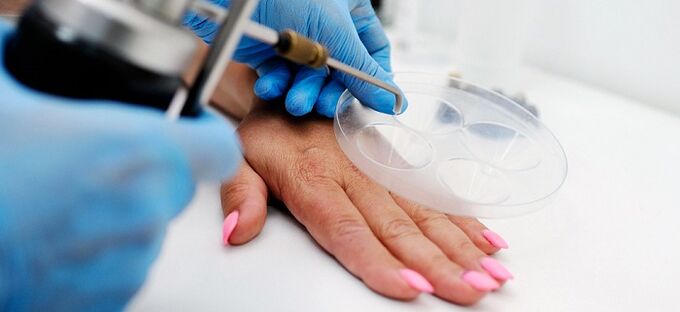
Should I remove the growth?
It depends on the size, nature and age of the person.But most often the answer is clearly yes, because warts are contagious and can spread to others.Self-infection is also possible - autoinoculation.
First of all, the infectiousness of tumors is manifested not only in direct contact with them, but also when we use common household items, personal hygiene items, or simply touch the places where the infected person has touched.For example, a bus stop.
Second time, the localization of the wart can be in a place that is subject to the greatest possible damage - the neck, feet, armpits, groin.These places are rubbed, pressed and touched by clothing more often than others.Then it is full of malignancy, bleeding and growth.
Third time, the size and quantity of the formations may increase, which causes aesthetic problems.This phenomenon can be called territorial occupation by a wart.
Important!Not always, but it can happen that a wart turns into melanoma, an incurable aggressive skin cancer.
Main misconceptions about the dangers of surgery
Early treatment and treatment of warts is the best solution.It saves a lot of time, effort and money.Although 70% of warts can disappear spontaneously after 2 years, they can just as easily return, and in new places.
Many people's fear of going to the surgeon is related to the fear of surgery, its complications, relapses and possible pain during the procedure.They are completely unfounded, since modern methods provide very good pain relief, and in many cases anesthesia is not required at all.
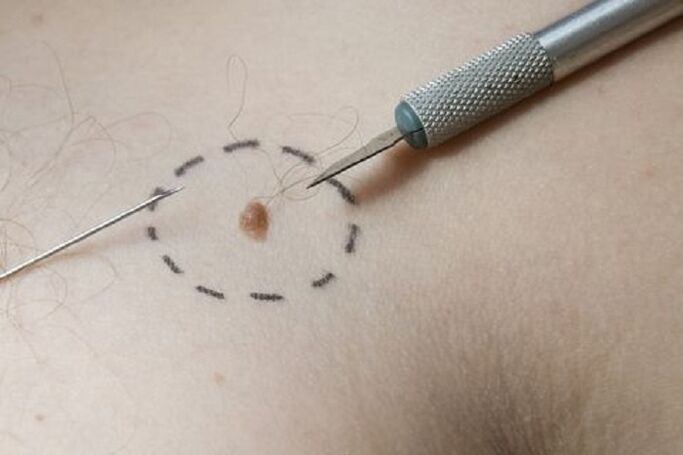
It is still widely believed that unnecessary touching of a wart with a scalpel will increase its growth.This is the deepest misconception - this is the surgical intervention that prevents the spread of the virus and prevents the growth of the wart.Fortunately, there are plenty of ways to do this.
Patients who are not afraid of traditional home methods and refuse professional help can be called strange.The doctor's experience and training are of course decisive, but a good surgeon is not rare.
And one more note - you don't need to rely on beauticians and rush to them with warts.They don't exactly have the necessary medical qualifications.
Modern methods
There are newer or older removal methods.Each has its advantages and disadvantages.In addition, the effect depends on the size, position and depth of growth of the wart.
All methods can be divided into 3 groups: hardware, surgical and chemical.Traditional treatment refers to the method of physical (mechanical) influence.
If you contact us, the doctor can suggest the best solution in his opinion, but the final decision is made by the patient himself.
Prior consultation is also necessary because not all chosen methods are suitable, as there are contraindications and restrictions.
Laser treatment
The laser method can be called universal.Of all the methods, it is the leader today.You can use a laser to remove warts in the most inaccessible, tender and painful places.It is also beneficial because it does not cause scars.The beam is the safest and least traumatic.
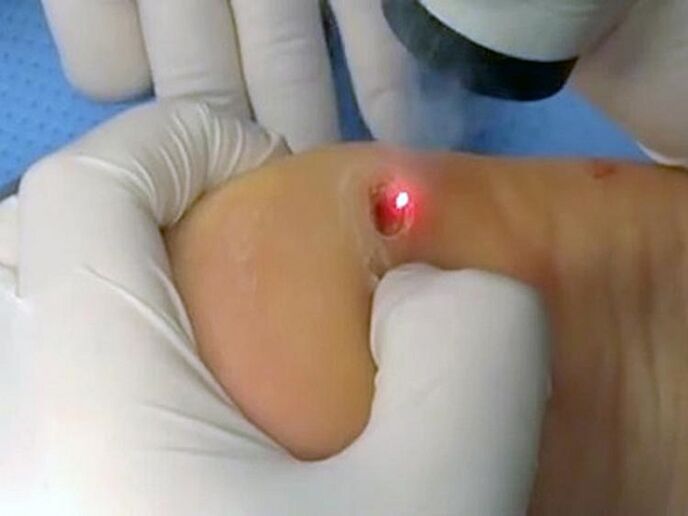
The efficiency is so high that one procedure is enough.The essence of the heat effect on the wart is burning from the temperature.Healing is fast, without scars or complications.
Additional advantages of the laser:
- the patient does not feel pain;
- no anesthesia is required;
- complete removal;
- fast - takes 1-2 minutes.Relapses are possible only in 20% of cases.
The burn leaves a hole that heals after 2 weeks.The skin may lighten temporarily, which goes away on its own after 3 weeks.
Cauterization with liquid nitrogen
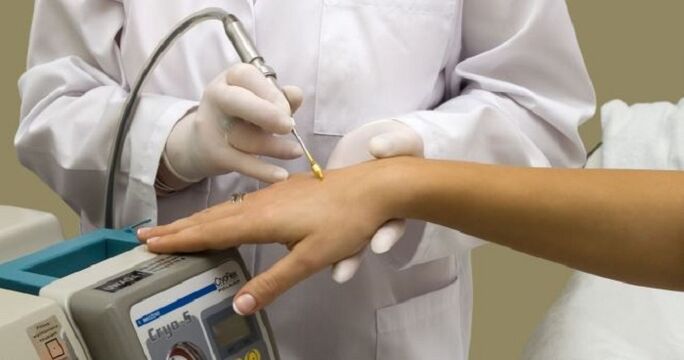
Cryodestruction is the freezing of a wart at a low temperature using liquid nitrogen.Duration - 30 seconds.Freezing causes the growth tissue to die.When exposed to frost, the papilloma thickens and turns white.After a minute it will be red and swollen.
A bubble with gray liquid appears at home.Within a week, it breaks through on its own and a crust forms.The crust will heal and fall off in 2 weeks.
A pink spot remains, gradually becoming the same color as the skin.The formation disappears within 2 weeks, and a spot with a pinkish tint appears at the place of removal, which gradually disappears.
Advantages:
- no pain, no scarring and no need for anesthesia;
- no infection or bleeding.
The only downside is that there is no way to control the depth of impact.
The effect on the soles lasts about 1 minute.The procedure can be repeated up to 5 times on the sole.The disadvantage is that the wound takes a long time to heal.
Electrocoagulation
Electrocoagulation of warts uses high-frequency currents.It is concentrated in a loop that cuts off the wart.The cauterization temperature is about 80 degrees.
No bleeding due to simultaneous coagulation of blood vessels.Local anesthesia is required.The great advantage of this method is that it prevents further spread of the virus.In addition, the method is quite cheap and effective.
The surrounding tissues should be covered and the skin should be disinfected beforehand.There is also a bark section.It will be gone within a week.After that, an almost imperceptible, transparent scar remains, but more often a light spot.No setbacks!
Application of radio wave therapy
The method is no less effective than electric current.Cauterization is performed with special tools;a doctor will help you choose the right one.This is a radio wave generator;its high-frequency electric waves do not touch the wart, but cut it off completely.
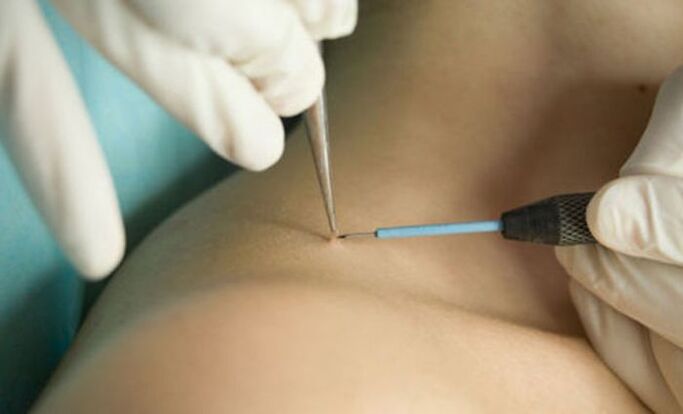
The essence of the action is that the wart cells contain liquid, which expands under the influence of radio waves, the wart swells and bursts.The work is done with a special tip that resembles a ballpoint pen.
No scarring or infection.The only downside is that the procedure is painful;for this reason, the growth is pre-lubricated with anesthetic.Healthy cells are not damaged.Cauterization takes about 20 minutes.
Advice!It should not be wetted or peeled while the bark is in its state.It will disappear on its own within a week.
Surgical excision
Surgical removal is a traditional, classic method performed with a scalpel.It is rarely used nowadays.The method is traumatic, causes relapses and scars.
There is a risk of damage to adjacent tissues and the possibility of infection.But it is essential if the wart is large.Under local anesthesia, the wart is scraped out using a special spoon after the incision.The stitches are cosmetic and are removed after a week.The scar remains approximately 3 mm in size and fades over time.
Chemical cauterization
The formation is targeted with acid or alkali.Wash it off after a certain time.Usually, at least 6 procedures are required to achieve the effect.A burning or tingling sensation may be felt during the procedure.The wart dries up and falls off.

Disadvantages:
- there is a risk of further spread of the virus and infection cannot be ruled out;
- healthy tissues are often damaged;
- Scars may occur, healing takes about 10 days.
This method is used only when other methods are not possible.
Advantages and disadvantages of different methods, which is better and which is better
Each removal method has its advantages and disadvantages;there are no ideal options.Today, the most popular methods are: laser therapy, cryotherapy, electrocoagulation, radio waves, surgical scalpel - with decreasing frequency of application.The cost of the first 3 methods is actually in the same price category.
The laser shows the way: there are no inaccessible places, safe, fast and painless.Cryodestruction is considered the second most effective, but with this there is no possibility to control the depth of exposure, due to which relapses are possible.
And one more conclusion - the laser can remove only 1 small formation in 1 session.
Cryotherapy can be used in the case of papillomatosis, when up to 40 growths can be removed with 1 procedure.But here the doctor's experience is very important in terms of quality.
How does the location and type of growth affect the choice of technique?
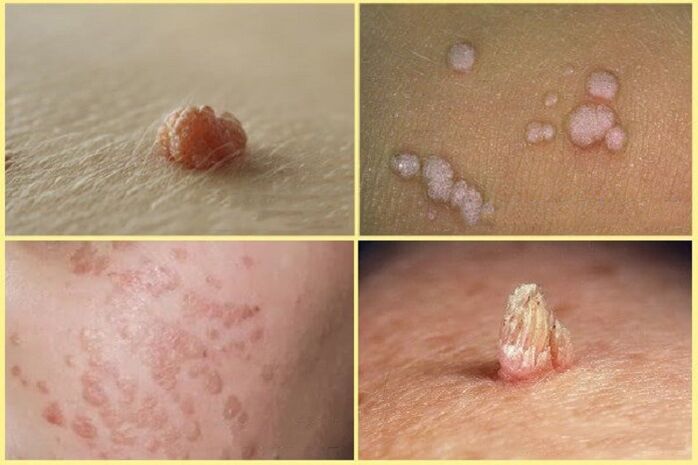
There are 4 types of warts:
- vulgar– in the form of small nodules, often growing on the fingers and toes, on the backs of the hands;
- flat– they appear in the form of protruding spots typical of teenagers;among these is also talpi (pinus);
- threaded (accro chords)– flexible thin growths on the stem that appear on the face (eyelids, lips) and neck;
- genital warts - most often localized on the mucous membrane of the genitals;They look like cauliflower.
These 4 types are of viral origin and belong to true warts.
But there are also senile keratomas, which are caused by functional disorders of the skin.They do not require treatment, only observation.If desired, cryotherapy can be used.
The doctor recommends the method of removal, but ultimately the patient chooses.How to choose a method depends on the type of wart: small formations can be safely removedradio wave "knife" or liquid nitrogen.
Radio knifeIt can be used on the face and neck, legs and palms, groin.It is not used for papillomas on the eyelids.They can use a laser or liquid nitrogen.
FreezingIt is also used on hands and feet (soles), papillomas on the neck.The cryo method can be called universal.Safe.
Laser— removes warts anywhere on the body, including under the nails.
Surgical methodused for large growths on the oral mucosa.
Electrocoagulationrecommended for flat and vulgar warts.It can even be used on the face.In the case of large formations, the effect is insignificant.Also, the electric knife is not used to treat plantar warts because they are usually deep-rooted and very dense.
Important!Plantar growths should only be removed in a hospital.
The chemical method gives good results for plantar lesions, flat and pointed.Physical methods are ineffective in comparison.
What method do doctors recommend for removing tumors?
Of course, the customer chooses according to his options.But to make the right decision, you should be guided by the doctor's opinion.Experts prefer the complex (combined) treatment of warts, where the leading place is removal.
In addition, treatment includes oral administration of antiviral drugs.Although the HPV virus (human papillomavirus) cannot be cured 100%, its activation largely depends on the state of the immune system, but it can be slowed down, put to sleep, and remission can be prolonged.
In addition to antiviral drugs, immunomodulators are also used for this purpose.This is primarily a group of interferons.
Doctors are not particularly enthusiastic about traditional methods, as the treatment is not carried out by doctors and it will not be safe.It is fraught with damage to the surrounding tissues, infection and inflammation.Warts cannot be removed by any method in children under 5 years of age.